Monday, October 16, 2006
Something the Press Wants Kept Secret
From Instapundit, comes this Telegraph story that the BBC apparently doesn't want to a report to be made public. Why? Because, if reports are accurate, it indicts their coverage of the Middle East. In particular, it might just show that it covers Israel negatively (big surprise).


The Liberating Veil

Friday, October 13, 2006
Passive Voice Watch and War on Terror
From today's The Corner, an interesting observation regarding current reporting. It reminds me of George Orwell's essay on politics and English language.
Press Passivity [Michael Rubin]
A writer with whom I spoke about two weeks ago pointed out a very interesting trend in the press reporting and political commentary about the war on terrorism. All too often, reporters and politicians use the passive voice.
Take British Foreign Secretary Margaret Beckett in yesterday’s USA Today: “It's widely argued now that the existence of the camp is as much a radicalizing and discrediting influence as it is a safeguard for security.” Well, who argues? A McClatchy story yesterday read, “Nearly 2,700 Iraqi civilians were killed in the city in September.” Well, who killed them? Baathist insurgents or Iranian-backed militias?
If the public read that Iranian-backed militias killed nearly 2700 civilians, we might be less willing to reward their murderers. From today’s New York Times: “Most of the 500 municipal workers who have been killed here since 2005 have been trash collectors.”
Again, someone did the killing. Why hide it? It’s important to know what we are up against.
I’d submit two conclusions: Journalists do not use the active voice because they do not know the subject of the action—in which case their editors should send them back to ask tough questions—or the editors wish to absolve the subjects for political reasons. Either way, it’s poor journalism and irresponsible punditry. Sorry to be a grammar nerd, but it’s time to have a passive voice watch.
Posted at 1:34 PM
UPDATE: Jonah adds a few more observations:
Re: Press Passivity [Jonah Goldberg]
Michael makes an excellent point. I'd add a few of other possible causes of the passivity:
Laziness: By phrasing things passively, reporters don't have to actually track down real quotes and assign accountability.
Copycatting: If the New York Times uses a certain style, it will catch on, regardless of the merits.
Globalization: Reuters has a policy of not using the word "terrorist" objectively in part because they are a global news service and some of their customers object when you call their preferred team terrorists. Similarly, CNN doesn't call anyone a "foreigner" because CNN fancies itself a global news service as well. Passive voice reporting might be a related phenomenon because it allows news outlets to avoid offending various consituencies, ideological and geographic.
Groupthink: Because the press as a "class" see the war with considerable unanimity, editors don't catch things which simply "sound right."
Condescention: When Iraqis kill Iraqis, some may reason, they aren't fully formed moral actors, but manifestations of Bush's folly simply acting the way Third Worlders do.
None of these are mutually exclusive and I'm sure there are others. Indeed, most of them overlap considerably. I just think that when trends like thos pop-up there are lots of reasons for them.
Posted at 2:00 PM
UPDATE 2: Curiosity (and some free time) got the best of me, so I went and found an on-line version of Orwell's essay, called "Politics and the English Language". In addition to his always timely observations about language and politics, it contains good advice for writers, such as this:
What is above all needed is to let the meaning choose the word, and not the other way around. In prose, the worst thing one can do with words is surrender to them. When you think of a concrete object, you think wordlessly, and then, if you want to describe the thing you have been visualising you probably hunt about until you find the exact words that seem to fit it. When you think of something abstract you are more inclined to use words from the start, and unless you make a conscious effort to prevent it, the existing dialect will come rushing in and do the job for you, at the expense of blurring or even changing your meaning. Probably it is better to put off using words as long as possible and get one's meaning as clear as one can through pictures and sensations. Afterward one can choose -- not simply accept -- the phrases that will best cover the meaning, and then switch round and decide what impressions one's words are likely to make on another person. This last effort of the mind cuts out all stale or mixed images, all prefabricated phrases, needless repetitions, and humbug and vagueness generally.
But, more apropos to Rubin and Goldberg above, Orwell talks about politicans and government publications: political orthodoxy of any kind purposefully hides full accounts of events and its actors.
Orthodoxy, of whatever colour, seems to demand a lifeless, imitative style. The political dialects to be found in pamphlets, leading articles, manifestos, White papers and the speeches of undersecretaries do, of course, vary from party to party, but they are all alike in that one almost never finds in them a fresh, vivid, homemade turn of speech.
Why? Because using the passive seeks to hide the hand of the puppeteer, focusing on the puppet or the results instead. It locates the action in a vacuum; it is a sleight of hand that most of us used when we hide the fact that our loose tongue got somebody else in trouble--"It came to be known that Mr. X does not like you." Political parties, Orwell says--and journalists are not exempt their own political pressures--, that the euphemisms (of which passive voice is a kind) allow to speak of an event in a diminished way. Passive voice then allows the speaker to hide the actor.
More:
In our time, political speech and writing are largely the defence of the indefensible. Things like the continuance of British rule in India, the Russian purges and deportations, the dropping of the atom bombs on Japan, can indeed be defended, but only by arguments which are too brutal for most people to face, and which do not square with the professed aims of the political parties. Thus political language has to consist largely of euphemism, question-begging and sheer cloudy vagueness.
Why? As brutal as the images main street media's coverage of the ravages that daily pour out of Iraq, they are only brutal with a part of the whole picture. And I am not merely talking out their ignoring the good news--which they do. I am talking about the subsequent diminishing of the role of the actors that results from focusing on the action. Part of it may in fact be the result of tv images always getting, by the very nature of the way events unfold, the carnage of the bombs or bullets, and not the immediately preceding action of the actors perpetrating their barbarities. At any rate, active voice connects actor to act; vivid action verbs do it to startle the reader out of his somnobletic Sunday afternoon reading to encounter an incarnation of a particular action that a particular person has done to particular people or person. There are three foci. Passive only two.
For instance: Compare this sentence
Bledsoe threw Glenn the footballwith
The football was thrown to Glenn (by Bledsoe).
Mark Twain's advice was: choosing the best word over an acceptable word was the difference between lightning and the lightning bug. Active voice strikes, passive glows. Passive voice does not quickens, it deadens.
Such phraseology [eg, euphemisms and passive voice] is needed if one wants to name things without calling up mental pictures of them.
Again, Orwell is concerned with members of the political class corrupting language, politics, and public opinion. But surely he would not discount the impact that the press has in the same realm? They are, after all, framing how many or most of us understand the way the world is. They do have, however, less and less control in this since cable news and talk radio expanded the perspectives possible. And, of course, the Internet has exploded the control and access to sources of news from the hands of a few to countless numbers of people throughout the world. In this light, as Jarvis, Andrew Sullivan and others have said, the Internet has done for people what the Gutenberg printing press did for people in the Reformation. It took the interpretation and reading of Scripture from the Church and gave a Bible (and its interpretation) to the mass of Europe's people.
For a free people, we do count on our government officials and leaders to give us as complete and unvarnished accounts of events affecting our lives and country. Despite mistakes in the recent past, I don't have any doubts that the Bush administration did and continues to do the best it can. (This was the prudential wisdom of keeping Clinton's heads of FBI and CIA well into his first term). But it is also necessary and good that the press exists to challenge, refine or refute what the government reports. However, it seems that the press is more ideologically wedded, as a political class, not to an accurate coverage of an unpredicatable situation whose outcome is by no means certain--in other words, a war--but to a position that seeks through a paritial coverage to lead its readers and viewers to turning this war into another Vietnam.
UPDATE 3: Michael Rubin says that Isaac Chotiner over at The New Republic's blog, The Plank, picked up on his original comment, listed above, and appears to defend, as Rubin says it, omitting the subject. It will be interesting to see his reply, if any.
Thursday, October 05, 2006
Education: For Now or Always?
Contrast
"No general education should be timeless," he said. "There’s no question it’s [education] a response to the world we live in now."With
[1.22]. . . . But he that desires to look into the truth of things done, and which (according to the condition of humanity) may be done again, or at least their like, he shall find enough herein to make him think it profitable. And it is compiled rather for an EVERLASTING POSSESSION, than to be rehearsed for a prize.
Michael Steele's Letter to Democrats
From the guys at Powerline comes news of this letter Steele directed to several Democrats regarding the latest of a train of low, partisan tricks trying to discredit a black Republican's run for US Senate from Maryland. I don't think it needs any further introduction. Its pretty self-explanatory.
October 4, 2006(Hat tip: Paul at Powerline)
Dear Congressman Cardin, Governor Dean, Chairman Lierman and Senator Schumer:
For several months, I have been trailed by Democrat operatives filming my public events. At these events – speeches, press conferences, county fairs and parades – my every word and move has been recorded.
I realize this has become a part of modern campaigning and I welcome the scrutiny. In fact, I always make a point to say a friendly hello to whomever the Democrat Party sends to follow me. However, recent actions have crossed the line from political activity to an invasion of privacy.
On the morning of September 30, I participated in a homecoming ceremony for the Army National Guard 243rd Engineers. The event – as fitting for the occasion – was non-political. Republicans and Democrats joined together to welcome home brave men and women returning from Iraq and I attended in my official capacity to spend time with the troops and their families.
While speaking with two mothers whose sons had died in Iraq, I noticed the ever present Democrat operative filming our conversation. A conversation with parents who have lost a loved one in combat is private in nature and has no place in partisan politics, and certainly not in the smear campaign you have waged against me even before I entered the race for United States Senate. The filming of this conversation demonstrates a callous disregard for families who have lost a loved one and is an indefensible invasion of privacy.
Unfortunately, I have come to expect such ugly, gutter politics from you. Congressman Cardin, while saying you have expressed outrage to “all concerned parties” for the racist comments on your senior staffer’s blog, you have yet to apologize to me. Chairman Dean, your personal pollster, Cornell Belcher, advocated racist attacks to “knock” me down and “discredit” me, and yet I have received no apology from you. And, Senator Schumer, your staffers pled guilty to a crime when they stole my credit report and violated my privacy and that of my family, but I have had no apology from you either.
I did not think until this past Saturday, however, that such ugliness would intrude upon the return of our troops from Iraq. As I told your colleague, Congressman Steny Hoyer, who attended the event, this action represents a new low in Maryland politics and has no place in this campaign.
My campaign is focused on having a conversation with the voters of our state about the issues affecting Maryland and I am committed to building bridges over that which divides us. But, ugly partisan political tricks only work to divide our communities and represent the very type of political behavior voters are sick of.
If your respective organizations are as concerned as I am about the use of such poor judgment by your staff(s), you would take immediate steps to hold all responsible parties accountable.
I eagerly await your prompt response.
Sincerely,
MICHAEL S. STEELE
Wednesday, October 04, 2006
Prime Minister Howard's Speech at the Quadrant
Glenn Reynolds pointed out a news story on this speech by Howard, given at the 50th Anniversary celebration of Quadrant, an Australian conservative journal of literature and ideas. I found it at the Prime Minister's website. It looks good. Though it really doesn't seem to focus on what the news story says it does.
As a matter of fact, the Australian article focuses unduly on what it calls Howard's "scathing attack" of the left's intelligentsia. They are more concerned with reporting that Howard bashed the left--quoting his litany of indictments as if they were reporting to the principal the string of names the bully lobbed against the weakest of the playground.
They don't appear to be overly concerned with sharing the premise of Howard's arguments: that the West has been in the throes of a battle of ideas for the last 60 or so years. And the main pivot points were individualism and collectivism, liberty under the law and overwhelming inevitable historical forces, liberal democratic and totalitarian governments. Or concerned with the conclusion of the Cold War: that those who advocated the West's ideals stood at the end of the day while the others were swept into the ash heap.
Today, the battle continues. Though this time, instead of capitalism, a great religion is hijacked by a minority who have been corrupted by the same ideas that were thought to be vanquished in the Cold War. The tyranny of our day is the resurrected tyranny of yesterday in different trappings, religious and not anti-capitalistic and atheistic, medieval and patriarchical not educated, tolerant, and sophisticated (though their western intellectual progenitors and advocates are).
There. A better summary of Howard's speech. But don't take my word for it, read it for yourself.
As a matter of fact, the Australian article focuses unduly on what it calls Howard's "scathing attack" of the left's intelligentsia. They are more concerned with reporting that Howard bashed the left--quoting his litany of indictments as if they were reporting to the principal the string of names the bully lobbed against the weakest of the playground.
They don't appear to be overly concerned with sharing the premise of Howard's arguments: that the West has been in the throes of a battle of ideas for the last 60 or so years. And the main pivot points were individualism and collectivism, liberty under the law and overwhelming inevitable historical forces, liberal democratic and totalitarian governments. Or concerned with the conclusion of the Cold War: that those who advocated the West's ideals stood at the end of the day while the others were swept into the ash heap.
Today, the battle continues. Though this time, instead of capitalism, a great religion is hijacked by a minority who have been corrupted by the same ideas that were thought to be vanquished in the Cold War. The tyranny of our day is the resurrected tyranny of yesterday in different trappings, religious and not anti-capitalistic and atheistic, medieval and patriarchical not educated, tolerant, and sophisticated (though their western intellectual progenitors and advocates are).
There. A better summary of Howard's speech. But don't take my word for it, read it for yourself.
Sunday, September 24, 2006
Victor Hanson Starts a Blog
If you haven't noticed, Victor Davis Hanson is now blogging over at PajamasMedia.com.
This is indeed good news. For me, his columns at his Private Papers website (over 2 million hits per month) have always been a valuable source of historical and military perspective so often missing in analysis of our wars and our times, but now, with his move to a blog, I hope we can see more spontaneous comments that I see and appreciate in his Q & A's. These I feel are of greater value.
Here, for example, is the final bit--a reoccurring theme for me--from his latest post on "Wars, Then and Now":
The rest, "War, Then and Now", can be read at Works and Days. --His blog, by the way, is named after one of the great Greek poets', Hesiod, works, Works and Days. But, VDH talks about it better:
This is indeed good news. For me, his columns at his Private Papers website (over 2 million hits per month) have always been a valuable source of historical and military perspective so often missing in analysis of our wars and our times, but now, with his move to a blog, I hope we can see more spontaneous comments that I see and appreciate in his Q & A's. These I feel are of greater value.
Here, for example, is the final bit--a reoccurring theme for me--from his latest post on "Wars, Then and Now":
The End of WarsIndeed.
Today I finish the last class of a five-week course I taught this late summer at Hillsdale College on World War II. What is striking is the abrupt end of the war, whose last months nevertheless saw the worst American casualties in Europe of the entire struggle. 10,677 of our soldiers died in April 1945 alone, just a few days before the collapse of the Nazi regime— about the same number lost a year earlier during the month of June in the 1944 landings at Normandy and the slogging in the Hedgerows. Okinawa saw our worst casualties on the ground in the Pacific—and was declared secure only 6 weeks before the Japanese surrender. 1945 was far bloodier than 1939, a reminder that in the midst of a war daily losses are not necessarily a barometer of how close or far away is the end of the carnage. Ask the Red Army for whom the final siege of Berlin—361, 367 Russian and Polish soldiers lost—may have been their worst single battle of their entire war, itself characterized by killing on a scale unimaginable in the West.
I don’t know how close or far away we are in Iraq from securing a chance for Iraqi democracy to stabilize, but I do know—despite the recent spate of doom and gloom journalistic accounts—that, as in all wars, it is almost impossible to tell from the 24-hour pulse of the battlefield.
The rest, "War, Then and Now", can be read at Works and Days. --His blog, by the way, is named after one of the great Greek poets', Hesiod, works, Works and Days. But, VDH talks about it better:
Hesiod was an ancient Greek poet who wrote about the world about him from the angle of the farmer. His Works and Days were a sort of a tough take about how hard life could be, and the world view that the no-nonsense farmer should adopt about the world about him if he were to survive. I have never posted blogs before but I will take Hesiod to heart here the beginning.
Tuesday, September 19, 2006
Ahmadinejad's Speech at the UN, 9-19-06
Here it is, from the UN website:
Address by
His Excellency Dr. Mahmoud Ahmadi-Nej ad
President of the Islamic Republic of Iran
before the 61 st Session of the General assembly
New York, 19 September 2006
Madam President, Distinguished Heads of State and Government, Distinguished Heads of Delegation, Excellencies, Ladies and Gentlemen
I praise the Merciful, All-Knowing and Almighty God for blessing me with another opportunity to address this Assembly on behalf of the great nation of Iran and to bring a number of issues to the attention of the international community.
I also praise the Almighty for the increasing vigilance of peoples across the globe, their courageous presence in different international settings, and the brave expression of their views and aspirations regarding global issues.
Today, humanity passionately craves commitment to the Truth, devotion to God, quest for Justice and respect for the dignity of human beings. Rejection of domination and aggression, defense of the oppressed,and longing for peace constitute the legitimate demand of the peoples of the world, particularly the new generations and the spirited youth, who aspire a world free from decadence, aggression and injustice, and replete with love and compassion. The youth have a right to seek justice and the Truth; and they have a right to build their own future on the foundations of love, compassion and tranquility. And, I praise the Almighty for this immense blessing.Page 1
Madame President, Excellencies,
What afflicts humanity today is certainly not compatible with human dignity; the Almighty has not created human beings so that they could transgress against others and oppress them.
By causing war and conflict, some are fast expanding their domination, accumulating greater wealth and usurping all the resources, while others endure the resulting poverty, suffering and misery.
Some seek to rule the world relying on weapons and threats, while others live in perpetual insecurity and danger.
Some occupy the homeland of others, thousands of kilometers away from their borders, interfere in their affairs and control their oil and other resources and strategic routes, while others are bombarded daily in their own homes; their children murdered in the streets and alleys of their own country and their homes reduced to rubble. Such behavior is not worthy of human beings and runs counter to the Truth, to justice and to human dignity. The fundamental question is that under such conditions, where should the oppressed seek justice? Who, or what organization defends the rights of the oppressed, and suppresses acts of aggression and oppression? Where is the seat of global justice?
A brief glance at a few examples of the most pressing global issues can further illustrate the problem.
A. The unbridled expansion of nuclear, chemical and biological weapons
Some powers proudly announce their production of second and third generations of nuclear weapons. What do they need these weapons for? Is the development and stockpiling of these deadly weapons designed to promote peace and democracy? Or, are these weapons, in fact, instruments of coercion and threat against other peoples and governments? How long should the people of the world live with the nightmare of nuclear, biological and chemical weapons? What bounds the powers producing and possessing these weapons? How can they be held accountable before the international community? And, are the inhabitants of these countries content with the waste of their wealth and resources for the production of such destructive arsenals? Is it not possible to rely on justice, ethics and wisdom instead of these instruments of death? Aren't wisdom and justice more compatible with peace and tranquility than nuclear, chemical and biological weapons? If wisdom, ethics and justice prevail, then oppression and aggression will be uprooted, threats will wither away and no reason will remain for conflict. This is a solid proposition because most global conflicts emanate from injustice, and from the powerful, not being contented with their own rights, striving to devour the rights of others.
People across the globe embrace justice and are willing to sacrifice for its sake.Page 2
Would it not be easier for global powers to ensure their longevity and win hearts and minds through the championing of real promotion of justice, compassion and peace, than through continuing the proliferation of nuclear and chemical weapons and the threat of their use?
The experience of the threat and the use of nuclear weapons is before us. Has it achieved anything for the perpetrators other than exacerbation of tension, hatred and animosity among nations?
B. Occupation of countries and exacerbation of hostilities
Occupation of countries, including Iraq, has continued for the last three years. Not a day goes by without hundreds of people getting killed in cold blood. The occupiers are incapable of establishing security in Iraq. Despite the establishment of the lawful Government and National Assembly of Iraq, there are covert and overt efforts to heighten insecurity, magnify and aggravate differences within Iraqi society, and instigate civil strife.
There is no indication that the occupiers have the necessary political will to eliminate the sources of instability. Numerous terrorists were apprehended by the Government of Iraq, only to be let loose under various pretexts by the occupiers. It seems that intensification of hostilities and terrorism serves as a pretext for the continued presence of foreign forces in Iraq.
Where can the people of Iraq seek refuge, and from whom should the Government of Iraq seek justice?
Who can ensure Iraq's security? Insecurity in Iraq affects the entire region. Can the Security Council play a role in restoring peace and security in Iraq, while the occupiers are themselves permanent members of the Council? Can the Security Council adopt a fair decision in this regard?
Consider the situation in Palestine:
The roots of the Palestinian problem go back to the Second World War. Under the pretext of protecting some of the survivors of that War, the land of Palestine was occupied through war, aggression and the displacement of millions of its inhabitants; it was placed under the control of some of the War survivors, bringing even larger population groups from elsewhere in the world, who had not been even affected by the Second World War; and a government was established in the territory of others with a population collected from across the world at the expense of driving millions of the rightful inhabitants of the land into a diaspora and homelessness. This is a great tragedy with hardly a precedent in history. Refugees continue to live in temporary refugee camps, and many have died still hoping to one day return to their land. Can any logic, law or legal reasoning justify this tragedy? Can any member of the United Nations accept such a tragedy occurring in their own homeland?
The pretexts for the creation of the regime occupying Al-Qods Al-Sharif are so weak that its proponents want to silence any voice trying to merely speak aboutPage 3
them, as they are concerned that shedding light on the facts would undermine the raison d'être of this regime, as it has. The tragedy does not end with the establishment of a regime in the territory of others. Regrettably, from its inception, that regime has been a constant source of threat and insecurity in the Middle East region, waging war and spilling blood and impeding the progress of regional countries, and has also been used by some powers as an instrument of division, coercion, and pressure on the people of the region. Reference to these historical realities may cause some disquiet among supporters of this regime. But these are sheer facts and not myth. History has unfolded before our eyes.
Worst yet, is the blanket and unwarranted support provided to this regime. Just watch what is happening in the Palestinian land. People are being bombarded in their own homes and their children murdered in their own streets and alleys. But no authority, not even the Security Council, can afford them any support or protection. Why?
At the same time, a Government is formed democratically and through the free choice of the electorate in a part of the Palestinian territory. But instead of receiving the support of the so-called champions of democracy, its Ministers and Members of Parliament are illegally abducted and incarcerated in full view of the international community.
Which council or international organization stands up to protect this brutally besieged Government? And why can't the Security Council take any steps?
Let me here address Lebanon:
For thirty-three long days, the Lebanese lived under the barrage of fire and bombs and close to 1.5 million of them were displaced; meanwhile some members of the Security Council practically chose a path that provided ample opportunity for the aggressor to achieve its objectives militarily. We witnessed that the Security Council of the United Nations was practically incapacitated by certain powers to even call for a ceasefire. The Security Council sat idly by for so many days, witnessing the cruel scenes of atrocities against the Lebanese while tragedies such as Qana were persistently repeated. Why?
In all these cases, the answer is self-evident. When the power behind the hostilities is itself a permanent member of the Security Council, how then can this Council fulfill its responsibilities?
C. Lack of respect for the rights of members of the international community
Excellencies,
I now wish to refer to some of the grievances of the Iranian people and speak to the injustices against them.Page 4
The Islamic Republic of Iran is a member of the IAEA and is committed to the NPT. All our nuclear activities are transparent, peaceful and under the watchful eyes of IAEA inspectors. Why then are there objections to our legally recognized rights? Which governments object to these rights? Governments that themselves benefit from nuclear energy and the fuel cycle. Some of them have abused nuclear technology for non-peaceful ends including the production of nuclear bombs, and some even have a bleak record of using them against humanity.
Which organization or Council should address these injustices? Is the Security Council in a position to address them? Can it stop violations of the inalienable rights of countries? Can it prevent certain powers from impeding scientific progress of other countries?
The abuse of the Security Council, as an instrument of threat and coercion, is indeed a source of grave concern.
Some permanent members of the Security Council, even when they are themselves parties to international disputes, conveniently threaten others with the Security Council and declare, even before any decision by the Council, the condemnation of their opponents by the Council. The question is: what can justify such exploitation of the Security Council, and doesn't it erode the credibility and effectiveness of the Council? Can such behavior contribute to the ability of the Council to maintain security?
Excellencies,
A review of the preceding historical realities would lead to the conclusion that regrettably, justice has become a victim of force and aggression.- Many global arrangements have become unjust, discriminatory and irresponsible as a result of undue pressure from some of the powerful;
- Threats with nuclear weapons and other instruments of war by some powers have taken the place of respect for the rights of nations and the maintenance and promotion of peace and tranquility;
- For some powers, claims of promotion of human rights and democracy can only last as long as they can be used as instruments of pressure and intimidation against other nations. But when it comes to the interests of the claimants, concepts such as democracy, the right of self-determination of nations, respect for the rights and intelligence of peoples, international law and justice have no place or value. This is blatantly manifested in the way the elected Government of the Palestinian people is treated as well as in the support extended to the Zionist regime. It does not matter if people are murdered in Palestine, turned into refugees, captured, imprisoned or besieged; that must not violate human rights.
- Nations are not equal in exercising their rights recognized by international law. Enjoying these rights is dependent on the whim of certain major powers.Page 5
- Apparently the Security Council can only be used to ensure the security and the rights of some big powers. But when the oppressed are decimated under bombardment, the Security Council must remain aloof and not even call for a ceasefire. Is this not a tragedy of historic proportions for the Security Council, which is charged with maintaining the security of countries?
- The prevailing order of contemporary global interactions is such that certain powers equate themselves with the international community, and consider their decisions superseding that of over 180 countries. They consider themselves the masters and rulers of the entire world and other nations as only second class in the world order.
Excellencies,
The question needs to be asked: if the Governments of the United States or the United Kingdom who are permanent members of the Security Council, commit aggression, occupation and violation of international law, which of the organs of the UN can take them to account? Can a Council in which they are privileged members address their violations? Has this ever happened? In fact, we have repeatedly seen the reverse. If they have differences with a nation or state, they drag it to the Security Council and as claimants, arrogate to themselves simultaneously the roles of prosecutor, judge and executioner. Is this a just order? Can there be a more vivid case of discrimination and more clear evidence of injustice?
Regrettably, the persistence of some hegemonic powers in imposing their exclusionist policies on international decision making mechanisms, including the Security Council, has resulted in a growing mistrust in global public opinion, undermining the credibility and effectiveness of this most universal system of collective security.
Excellencies,
How long can such a situation last in the world? It is evident that the behavior of some powers constitutes the greatest challenge before the Security Council, the entire organization and its affiliated agencies.
The present structure and working methods of the Security Council, which are legacies of the Second World War, are not responsive to the expectations of the current generation and the contemporary needs of humanity.
Today, it is undeniable that the Security Council, most critically and urgently, needs legitimacy and effectiveness. It must be acknowledged that as long as the Council is unable to act on behalf of the entire international community in a transparent, just and democratic manner, it will neither be legitimate nor effective. Furthermore, the direct relation between the abuse of veto and the erosion of the legitimacy and effectiveness of the Council has now been clearly and undeniably established. We cannot, and should not, expect the eradication, or even containment, of injustice, imposition and oppression without reforming the structure and working methods of the Council.Page 6
Is it appropriate to expect this generation to submit to the decisions and arrangements established over half a century ago? Doesn't this generation or future generations have the right to decide themselves about the world in which they want to live?
Today, serious reform in the structure and working methods of the Security Council is, more than ever before, necessary. Justice and democracy dictate that the role of the General Assembly, as the highest organ of the United Nations, must be respected. The General Assembly can then, through appropriate mechanisms, take on the task of reforming the Organization and particularly rescue the Security Council from its current state. In the interim, the Non-Aligned Movement, the Organization of the Islamic Conference and the African continent should each have a representative as a permanent member of the Security Council, with veto privilege. The resulting balance would hopefully prevent further trampling of the rights of nations.
Madame President, Excellencies,
It is essential that spirituality and ethics find their rightful place in international relations. Without ethics and spirituality, attained in light of the teachings of Divine prophets, justice, freedom and human rights cannot be guaranteed.
Resolution of contemporary human crises lies in observing ethics and spirituality and the governance of righteous people of high competence and piety.
Should respect for the rights of human beings become the predominant objective, then injustice, ill-temperament, aggression and war will fade away.
Human beings are all God's creatures and are all endowed with dignity and respect.
No one has superiority over others. No individual or states can arrogate to themselves special privileges, nor can they disregard the rights of others and, through influence and pressure, position themselves as the "international community".
Citizens of Asia, Africa, Europe and America are all equal. Over six billion inhabitants of the earth are all equal and worthy of respect.
Justice and protection of human dignity are the two pillars in maintaining sustainable peace, security and tranquility in the world.
It is for this reason that we state:
Sustainable peace and tranquility in the world can only be attained through justice, spirituality, ethics, compassion and respect for human dignity.
All nations and states are entitled to peace, progress and security.
We are all members of the international community and we are all entitled to insist on the creation of a climate of compassion, love and justice.Page 7
All members of the United Nations are affected by both the bitter and the sweet events and developments in today's world.
We can adopt firm and logical decisions, thereby improving the prospects of a better life for current and future generations.
Together, we can eradicate the roots of bitter maladies and afflictions, and instead, through the promotion of universal and lasting values such as ethics, spirituality and justice, allow our nations to taste the sweetness of a better future.
Peoples, driven by their divine nature, intrinsically seek Good, Virtue, Perfection and Beauty. Relying on our peoples, we can take giant steps towards reform and pave the road for human perfection. Whether we like it or not, justice, peace and virtue will sooner or later prevail in the world with the will of Almighty God. It is imperative, and also desirable, that we too contribute to the promotion of justice and virtue.
The Almighty and Merciful God, who is the Creator of the Universe, is also its Lord and Ruler. Justice is His command. He commands His creatures to support one another in Good, virtue and piety, and not in decadence and corruption.
He commands His creatures to enjoin one another to righteousness and virtue and not to sin and transgression. All Divine prophets from the Prophet Adam (peace be upon him) to the Prophet Moses (peace be upon him), to the Prophet Jesus Christ (peace be upon him), to the Prophet Mohammad (peace be upon him), have all called humanity to monotheism, justice, brotherhood, love and compassion. Is it not possible to build a better world based on monotheism, justice, love and respect for the rights of human beings, and thereby transform animosities into friendship?
I emphatically declare that today's world, more than ever before, longs for just and righteous people with love for all humanity; and above all longs for the perfect righteous human being and the real savior who has been promised to all peoples and who will establish justice, peace and brotherhood on the planet.
0, Almighty God, all men and women are Your creatures and You have ordained their guidance and salvation. Bestow upon humanity that thirsts for justice, the perfect human being promised to all by You, and make us among his followers and among those who strive for his return and his cause.Page 8
Monday, September 18, 2006
Khaleel Mohammed On the English Translations of the Koran
Michael Rubin encourages readers to consult Khaleel Mohammed in order to educate themselves to the differences in the English translations of the Koran. I didn't even know there were different versions.
Here is Khaleel's intro:
Here is Khaleel's intro:
Multiple English translations of the Qur'an, Islam's scripture, line shelves at book stores. Amazon.com sells more than a dozen. Because of the growing Muslim communities in English-speaking countries, as well as greater academic interest in Islam, there has been a blossoming in recent years of English translations. Muslims view the Qur'an as God's direct words revealed in Arabic to the Prophet Muhammad (d. 632).[1] Because the Qur'an stresses its Arabic nature, Muslim scholars believe that any translation cannot be more than an approximate interpretation, intended only as a tool for the study and understanding of the original Arabic text.[2] Since fewer than 20 percent of Muslims speak Arabic, this means that most Muslims study the text only in translation. So how accurate are the Qur'an's renderings into English? The record is mixed. Some are simply poor translations. Others adopt sectarian biases, and those that are funded by Saudi Arabia often insert political annotation. Since translators seek to convey not only text but also meaning, many rely on the interpretation (tafsir) of medieval scholars in order to conform to an "orthodox" reading.Read the rest here.
1946 Analysis of the Islamic Threat
Just discovered Steve Hayward's post on this, a Middle East Forum's publication of a US military intelligence's report of the long-term threats to global security in 1946. In that then classified report, we apparently get an unvarnished assessment of the factors foreseen to give rise to the Islamic threat from the Middle East to the rest of the world in the not too distant future. And, guess what, the presence of nation of Israel is not one of them.... Why? Israel was declared a state in 1948, 2 years after the report.
Here is Middle East Forum's summary of the report:
Here is Middle East Forum's summary of the report:
In 1946, U.S. power was on the ascent. A U.S. nuclear bomb had hastened the end of World War II and, while the Cold War was beginning, the United States remained the world's only nuclear power. As the international community rebuilt from the ashes of war and the United Nations sought to preserve peace, the military intelligence division of the U.S. War Department—the predecessor of today's Defense Intelligence Agency—charged its analysts to speculate on long-term threats to global security. One resulting essay, which appeared in the classified periodical Intelligence Review,[1] identified the Islamic world as a region of concern.But, don't take my word for it, read it all here.
Written just over than six decades ago, the resulting analysis is prescient.[2] The report describes a region beset by "discontent and frustration" and handicapped by a collective inferiority complex, yet unable to overcome "intellectual inaction," a situation which would keep the region from advancing in the modern world. The analysts speculate correctly about the growing importance of the Arab media and the divisive force of nationalism.
Ironically, while many academics today would dismiss as culturally insensitive the authors' frankness and generalizations about peoples and religion, the assumption that culture matters holds true. Many of the report's observations mirror those made in recent years by the United Nations' own Arab Human Development Report, which, if anything, is more pessimistic. In 1946, observers of the Middle East still had hope that increasing literacy and ease of travel would lead the region to become more cosmopolitan. While they raised concerns about nascent Islamist movements, they did not foresee just how malignant such groups could become, nor did they envision that oil-rich states such as Saudi Arabia would fund extremism rather than regional development.
As important as what the authors do say is what they do not. While it has become trendy in some academic and diplomatic circles to blame terrorism and regional instability on Israel's existence, the War Department's report suggests these problems—and anti-Semitism as well—predated the Jewish state. Many Arab states complained about Jewish immigration to Palestine, but the report's authors suggest local governments cynically promoted such concerns, and Muslims farther afield had different priorities. Well before Israel's independence and the 1967 war, Arab and Islamist groups embraced terrorism, using it for purposes unrelated to Zionism. Accordingly, while the scapegoating of Israel may be fashionable in the foreign ministries of Arab states, the European Union, and the diplomatic parlors of the United Nations, the 1946 report shows that responsibility for the political, economic, and social failings of the region are far more complex and deeply-rooted.
—The Editors
Sunday, September 10, 2006
On Waugh's Black Mischief
Over at my other blog, I've posted on AEI scholar Mark Falcoff's review of Evelyn Waugh's novel Black Mischief. I note i t here because of its contemporary poltical relevance--the interaction of western ideals and 3rd world realities.
Read it here: Philomythos: Waugh's Black Mischief.
Read it here: Philomythos: Waugh's Black Mischief.
Monday, August 28, 2006
Death of Multiculturalism
Reynolds draws out attention to a Rod Liddle and a Shelby Steele column on "white guilt" or multiculturalism myth that blinkers westerners in our war on terror. Here is Liddle in the Times:
Quick, somebody buy a wreath. Last week marked the passing of multiculturalism as official government doctrine. No longer will opponents of this corrosive and divisive creed be silenced simply by the massed Pavlovian ovine accusation: “Racist!” Better still, the very people who foisted multiculturalism upon the country are the ones who have decided that it has now outlived its usefulness — that is, the political left.From Shelby Steele's column:
It is amazing how a few by-election shocks and some madmen with explosive backpacks can concentrate the mind. At any rate, British citizens, black and white, can move onwards together — towards a sunlit upland of monoculturalism, or maybe zeroculturalism, whatever takes your fancy.
* That multiculturalism really is officially dead and buried can be inferred both from Ruth Kelly’s comments last week and, indeed, from the title of the commission that the government had convened in the wake of the July 7 terrorist attacks last year and to which her observations were made.
Over and over, white guilt turns the disparity in development between Israel and her neighbors into a case of Western bigotry. This despite the fact that Islamic extremism is the most explicit and dangerous expression of human bigotry since the Nazi era. Israel's historical contradiction, her torture, is to be a Western nation whose efforts to survive trap her in the moral mazes of white guilt. Its national defense will forever be white aggression.
But white guilt's most dangerous suppression is to keep from discussion the most conspicuous reality in the Middle East: that the Islamic world long ago fell out of history. Islamic extremism is the saber-rattling of an inferiority complex. America has done a good thing in launching democracy as a new ideal in this region. Here is the possibility--if still quite remote--for the Islamic world to seek power through contribution rather than through menace.
Sunday, August 27, 2006
World Wars in the 21st Century
Niall Ferguson in the latest Foreign Affairs looks back to the 20th Century before looking ahead:
The twentieth century was the bloodiest era in history. Despite the comfortable assumption that the twenty-first will be more peaceful, the same ingredients that made the last hundred years so destructive are present today. In particular, a conflict in the Middle East may well spark another global conflagration. The United States could prevent such an outcome -- but it may not be willing to.Wretchard at Belmont Club concludes his commentary on Niall Ferguson's thesis this way:
Yet those effete-looking internationalists probably grasp Niall Ferguson's point at a gut level: without an American gorilla under "internationalist" direction, The Next War of the Worlds may be in the offing. Yet to America, as the Ring was to Tom Bombadil, empire is too much of a burden. America's mystical faith that all countries desire freedom may partly be at bottom a wish that the world would leave it alone; leave it alone to watch a baseball game with a cup of weak beer in one hand and soggy hot dog in the other, neither knowing nor caring where Iraq or Kazakhstan was. And so it was until the airliners crashed into Manhattan in 2001. Who knows what it is now?
Humilating Americans
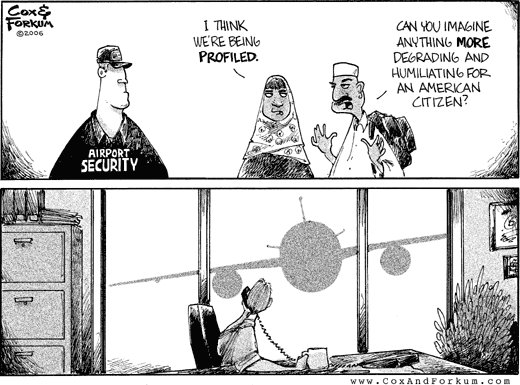
The latest Cox and Forkum is an appropriate response to this news from Reuters:
NEW YORK (Reuters) - The American Civil Liberties Union and a leading Islamic group on Wednesday accused security officials at New York's JFK airport of racially profiling Muslims.(ht: Larry Kudlow)
"The price to pay for racial profiling is too high," Dennis Parker of the American Civil Liberties Union told a news conference. "All people should be treated in the same way regardless of their race, their ethnicity or their religion."
Saturday, August 26, 2006
Hitchens Flipping off the Frivolous
 This is making waves....
Newsbusters has transcripts and video clips of Christopher Hitchens (not, by the way, your typical Bush-supporter to say the least) flipping off Bill Mahrer's audience for frivolously equating the political goals of Iranian President Ahmadinejad and Bush just because they share similar apocalyptic visions of the end times.
Hitchens called such understanding as "frivolous". According to Websters, frivolous means:
- a: of little weight or importance b: having no sound basis (as in fact or law)
- a: lacking in seriousness b: marked by unbecoming levity
Hitchens: “Cheer yourself up like that [by jeering]. The President has said, [in] quite a great contrast before the podium of the Senate, I think, applauded by most present, in his State of the Union address, that we support the democratic movement of the Iranian people to be free of theocracy -- not that we will impose ourselves on them, but that if they fight for it we're on their side. That seems to be the right position to take, jeer all you like.”What he said.
(ht: Glenn Reynolds)
Thursday, August 24, 2006
Interesting Recent Readings
- Paul M. has some good news in Israeli politics.
- More than a few people say how different (that is, better) Bush is outside D.C.
- And related to that, Peter Schramm points out that Bush isn't as uncuriousier as he is made out to be.
- Peter also links up Juan Williams with Bill Cosby. What will they think of next?.....
- Michael Barone talks about ABC's 5-hour special on 9-11, scheduled for the 10th and 11th of September
- From Glenn Reynolds, a poll showing that Iraqis in Iraq are more positive about Iraq's progress than Americans are
Sunday, August 13, 2006
Crittenden's Psalm 9-11: I Will Fear No Evil
I can confirm Scott's strong encouragment to read Jules Crittenden's column in the Boston Herald today. It offers, I want to propose, a good antidote, invoking Sharansky (below), to the blindness of our time to see evil.
There are men out there who want us dead. This is undeniable. They want to see us all dead. Each and every one of us. They don’t know our names, they don’t know what our thoughts are about their grievances. They don’t know what our actions are and how we’ve lived our lives. They don’t care. They just want us dead.UPDATE: Scott follows up his post on Crittenden's column above with a new post about Crittenden, called "Meet Jules Crittenden".
I wish I had a sweet, comforting post-Sept. 11 lullaby to sing the ones I love to sleep when they experience fear of these evil men. But I don’t. Lullabies combat false monsters. Real monsters require something different.
Psalms, like lullabies, give comfort. But they don’t mask or deny the threat. They embrace it, and show the way to strength and ultimately comfort from within. What might a psalm say to anyone whose 9/11 fears have been reawakened.
Tuesday, August 08, 2006
Omar Fadhil on the Shia Armageddon
Cliff May points out that Omar Fadhil, co-founder of the blog Iraq the Model, in the Philadelphia Inquirer proposed the same idea last Friday that Bernard Lewis does today in the WSJ (immediately below).
As an observer of the conflict from Iraq, I see the signs that Iran may be starting to launch the mullahs' version of an Armageddon, exploiting the religious beliefs of devout Shiites in the region. While this may sound more the stuff of prophecies than international relations, it is important to understand - especially in countries such as Lebanon and Iraq that have large Shiite populations.Read it all.
Bernard Lewis: Apocalypse on August 22?
Here's Lewis' sobering opinion column that alot of people have been talking about, published today in Wall Street Journal. It is behind a subscription wall, but I believe this version is complete. Thanks DFME.
During the Cold War, both sides possessed weapons of mass destruction, but neither side used them, deterred by what was known as MAD, mutual assured destruction. Similar constraints have no doubt prevented their use in the confrontation between India and Pakistan. In our own day a new such confrontation seems to be looming between a nuclear-armed Iran and its favorite enemies, named by the late Ayatollah Khomeini as the Great Satan and the Little Satan, i.e., the United States and Israel. Against the U.S. the bombs might be delivered by terrorists, a method having the advantage of bearing no return address. Against Israel, the target is small enough to attempt obliteration by direct bombardment.The Discerning Texan provides some analysis and more background.
It seems increasingly likely that the Iranians either have or very soon will have nuclear weapons at their disposal, thanks to their own researches (which began some 15 years ago), to some of their obliging neighbors, and to the ever-helpful rulers of North Korea. The language used by Iranian President Ahmadinejad would seem to indicate the reality and indeed the imminence of this threat.
Would the same constraints, the same fear of mutual assured destruction, restrain a nuclear-armed Iran from using such weapons against the U.S. or against Israel?
There is a radical difference between the Islamic Republic of Iran and other governments with nuclear weapons. This difference is expressed in what can only be described as the apocalyptic worldview of Iran's present rulers. This worldview and expectation, vividly expressed in speeches, articles and even schoolbooks, clearly shape the perception and therefore the policies of Ahmadinejad and his disciples.
Even in the past it was clear that terrorists claiming to act in the name of Islam had no compunction in slaughtering large numbers of fellow Muslims. A notable example was the blowing up of the American embassies in East Africa in 1998, killing a few American diplomats and a much larger number of uninvolved local passersby, many of them Muslims. There were numerous other Muslim victims in the various terrorist attacks of the last 15 years.
The phrase "Allah will know his own" is usually used to explain such apparently callous unconcern; it means that while infidel, i.e., non-Muslim, victims will go to a well-deserved punishment in hell, Muslims will be sent straight to heaven. According to this view, the bombers are in fact doing their Muslim victims a favor by giving them a quick pass to heaven and its delights--the rewards without the struggles of martyrdom. School textbooks tell young Iranians to be ready for a final global struggle against an evil enemy, named as the U.S., and to prepare themselves for the privileges of martyrdom.
A direct attack on the U.S., though possible, is less likely in the immediate future. Israel is a nearer and easier target, and Mr. Ahmadinejad has given indication of thinking along these lines. The Western observer would immediately think of two possible deterrents. The first is that an attack that wipes out Israel would almost certainly wipe out the Palestinians too. The second is that such an attack would evoke a devastating reprisal from Israel against Iran, since one may surely assume that the Israelis have made the necessary arrangements for a counterstrike even after a nuclear holocaust in Israel.
The first of these possible deterrents might well be of concern to the Palestinians--but not apparently to their fanatical champions in the Iranian government. The second deterrent--the threat of direct retaliation on Iran--is, as noted, already weakened by the suicide or martyrdom complex that plagues parts of the Islamic world today, without parallel in other religions, or for that matter in the Islamic past. This complex has become even more important at the present day, because of this new apocalyptic vision.
In Islam, as in Judaism and Christianity, there are certain beliefs concerning the cosmic struggle at the end of time--Gog and Magog, anti-Christ, Armageddon, and for Shiite Muslims, the long awaited return of the Hidden Imam, ending in the final victory of the forces of good over evil, however these may be defined. Mr. Ahmadinejad and his followers clearly believe that this time is now, and that the terminal struggle has already begun and is indeed well advanced. It may even have a date, indicated by several references by the Iranian president to giving his final answer to the U.S. about nuclear development by Aug. 22. This was at first reported as "by the end of August," but Mr. Ahmadinejad's statement was more precise.
What is the significance of Aug. 22? This year, Aug. 22 corresponds, in the Islamic calendar, to the 27th day of the month of Rajab of the year 1427. This, by tradition, is the night when many Muslims commemorate the night flight of the prophet Muhammad on the winged horse Buraq, first to "the farthest mosque," usually identified with Jerusalem, and then to heaven and back (c.f., Koran XVII.1). This might well be deemed an appropriate date for the apocalyptic ending of Israel and if necessary of the world. It is far from certain that Mr. Ahmadinejad plans any such cataclysmic events precisely for Aug. 22. But it would be wise to bear the possibility in mind.
A passage from the Ayatollah Khomeini, quoted in an 11th-grade Iranian schoolbook, is revealing. "I am decisively announcing to the whole world that if the world-devourers [i.e., the infidel powers] wish to stand against our religion, we will stand against their whole world and will not cease until the annihilation of all them. Either we all become free, or we will go to the greater freedom which is martyrdom. Either we shake one another's hands in joy at the victory of Islam in the world, or all of us will turn to eternal life and martyrdom. In both cases, victory and success are ours."
In this context, mutual assured destruction, the deterrent that worked so well during the Cold War, would have no meaning. At the end of time, there will be general destruction anyway. What will matter will be the final destination of the dead--hell for the infidels, and heaven for the believers. For people with this mindset, MAD is not a constraint; it is an inducement.
How then can one confront such an enemy, with such a view of life and death? Some immediate precautions are obviously possible and necessary. In the long term, it would seem that the best, perhaps the only hope is to appeal to those Muslims, Iranians, Arabs and others who do not share these apocalyptic perceptions and aspirations, and feel as much threatened, indeed even more threatened, than we are. There must be many such, probably even a majority in the lands of Islam. Now is the time for them to save their countries, their societies and their religion from the madness of MAD.
Mr. Lewis, professor emeritus at Princeton, is the author, most recently, of "From Babel to Dragomans: Interpreting the Middle East" (Oxford University Press, 2004).
Saturday, August 05, 2006
Ahmed Al-Jarallah on the Fate of Dictatorships
It is interesting to read things like this in a column of a newspaper in the Middle East, The Arab Times to be exact. The writer is apparently the Editor-In-Chief.
I wonder, would we be seeing such comments in the Middle East if Saddam were still in power?
(ht: Cliff May at Corner)
Nasrallah’s dictatorship will sink like those of Saddam Hussein and other regimes, which did not know their true ability. Egyptians suffered under the dictatorship of the late Gamal Abdul Nasser who led them to war in 1967. The late Egyptian President believed Arab power can defeat Israel. However, the result was different as Arabs were handed out a humiliating defeat. Nasrallah, who is being remote-controlled by Iran and Syria, believes he is in the mold of many Arab leaders. But the fact is he is playing with fire.Read the rest of Ahmed Al-Jarallah's editorial here.
I wonder, would we be seeing such comments in the Middle East if Saddam were still in power?
(ht: Cliff May at Corner)
Thursday, August 03, 2006
Bloggers Raise Questions about Kana
Today's Jerusalem Post has the story.
According to the blogs, perhaps the most suspicious element in the Kana affair was the fact that the dead children whose photographs appeared in the media displayed virtually no signs of blood, bruises or broken bones and, with one exception, were not caked with debris or pulverized cement.
For example, according to the antiliberal Conservative Yankee blog, "The child in the photo shows no signs of injuries - no blood, no disfigurement or crushing wounds consistent with a building collapse. The two men [carrying the child] show no signs of having been digging in rubble. Their clothes are unbelievably clean, especially the black fatigues that would so easily shown concrete dust."
Wednesday, August 02, 2006
A Red Sox on Castro
In today's Boston Herald, Boston Red Sox's Third baseman Mike Lowell says this about life under Castro:


“My dad had to pack up his suitcase at 10 years old with his three brothers, who had nothing. And my mother was 11 years old and my grandfather, who’d been a dentist for 15 or 20 years, had to go back to school to be (politically) re-educated,” Lowell said.
“My cousins were political prisoners. My father-in-law was a political prisoner for 15 years because, at 19, they asked him if he agreed with communism and he said, ‘No,’ so they sentenced him to death. That’s not the way to live. I know it’s terrible to say, but I think of all of that and I hope he (Castro) passes away."
Tuesday, August 01, 2006
Kriesler Interviews Michael Oren
And here is Harry Kriesler's interview with Michael Oren (also mentioned below, two posts below to be exact). Also discovered as a result of VDH's recommendation. The date of the interview is November 8 2005.
Soldier. Historian. Novelist. Advisor. Sounds like an interesting fellow.
Soldier. Historian. Novelist. Advisor. Sounds like an interesting fellow.
Fouad Ajami on Syria's Control of Lebanon
Post immediately below prompted me to a do a google on Fouad Ajami and I found his piece, The Autumn of Autocrats, on Lebanon in Foreign Affairs. It seems helpful for background, right now, on the showdown between Israel and Hezbollah (in Lebanon). The piece is dated June 2005 and refers to events earlier that year.
Here is the magazine's summary:
Here is the magazine's summary:
Summary: If the assassins of former Lebanese Prime Minister Rafiq Hariri sought to make an example of him for his defiance of Syria, the aftermath of the crime has mocked them. For a generation, Lebanon was an appendage of Syrian power. But now the Lebanese people, in an "independence intifada," are clamoring for a return to normalcy. The old Arab edifice of power has survived many challenges in the past, but something is different this time: the United States is now willing to gamble on freedom.Read it here.
Monday, July 31, 2006
Today's Q & A with Victor Hanson
A Reader's Question:
Q. What reading would you suggest for someone wanting to understand the historical origins of the conflicts in the Middle East, as well as general reading on the history of the Middle East.
A. I reviewed Fouad Ajami's The Foreigner's Gift for the next issue of Commentary and found it very insightful. Michael Oren's Six Days of War has valuable information well beyond the 1967 war, and, of course, Bernard Lewis's, What Went Wrong was the first really to reject the 'colonialist, racist, imperialist' mantra of the 1980s. More controversial are the more recent Londonistan by Melanie Phillips and Bruce Bawer's While Europe Slept: How Radical Islam Is Destroy the West from Within.
There are roughly two schools of thought: Madrid, London, Beslan, India, Manhattan, Bali, and other jihadist attacks have no connection. Radical Islam is a figment of the paranoid ethnocentric Western imagination, while the real problem is U.S. and Israeli imperialism and the rise of the police state nurtured on Islamophobia, which sums up sentiment on the European street. In contrast, most in the U.S. accept that Islamic fascism is a disease spreading, like its autocratic precursors, throughout the Middle East and offering a cheap victimization and scapegoating for mostly self-inflicted miseries. So that is the great divide in the West, and I'm afraid the appeasers seem to be winning.
Subscribe to:
Posts (Atom)