Monday, May 28, 2007
Friday, May 25, 2007
Aristotle's Greatness of Soul
Peter Lawler posts this:
Greatness of Soul
Here's a comment I got on the thread below:A quick and obvious point in light of the discussion on No Left Turns: Aristotle's treatment of the magnanimous man in the Ethics for the most part oscillates between a report of what he thinks of himself and what other non-magnanimous men say about him. Unlike the discussion of Socrates' magnanimity in the Posterior Analytics, Aristotle here largely treats magnanimity from the perspective of the city and hence political life.
I agree with you that as Aristotle tends to present him in the Ethics, the magnanimous man is the paradigmatic example of the overly stuffed shirt-he thinks (and others think he thinks) that nothing is greater than himself and that no one can perform the great deeds he can. For this reason, he is "slow to act and procrastinates, except when some great honor is at stake; his actions are few but they are great and distinguished"--interestingly in this last statement Aristotle speaks in his own name.
As you point out, the magnanimous man tends to think about himself in abstraction from everyone else; this explains his belief in his own self-sufficiency. And as you also note, this is most obviously the case in his indifference or unwillingness to wonder and our related need for love and friendship.
Yet, to me, Aristotle presents the magnanimous man as being aware of a chink in his armor; in particular he seems to have nagging doubts and perhaps a begrudging recognition of his greatness resting on others. To the extent that he thinks in terms of great political actions, the magnanimous man must on some level recognize that he is dependent on the city and its citizens-at least in terms of it providing opportunities-for his actions. His estimation of himself rests in part on his, to be sure, unstated recognition that he must live with other men in order to act magnanimously and in order to be honored as magnanimous.
One cannot really think of himself as a magnanimous man if he lives alone or among a small group of human beings. Rather, he needs the venue on which his "great and distinguished" actions can be performed and put on display.
This also raises the related problem of potential frustrations that would nag a man who thinks he may be magnanimous: what if one lives at a time when "great and distinguished" actions are not needed or called for--this obviously gets expressed in your criticism of the end of history thesis.
But apart from the fictive and undesirable nature of an end of history, it may well be the case that the greatest external impediment to magnanimity is the failure of a human being to live in truly interesting-hence humanly fertile-times.
Tuesday, May 22, 2007
Kerrey: Centrality of the War in Iraq
By way of Bill Bennett's radio program this morning came notice of former Democratic Senator and Presidential candidate now New School President's, Bob Kerrey, commentary on liberals and supporting the War. It is must reading.
It is entitled "The Left's Iraq Muddle". He begins with a concise restatement of the justifications for deposing Saddam and he does so by invoking the tried and true American foreign policy that believes democracies can be imposed by military.
Here is the key part:
It is entitled "The Left's Iraq Muddle". He begins with a concise restatement of the justifications for deposing Saddam and he does so by invoking the tried and true American foreign policy that believes democracies can be imposed by military.
Here is the key part:
American liberals need to face these truths: The demand for self-government was and remains strong in Iraq despite all our mistakes and the violent efforts of al Qaeda, Sunni insurgents and Shiite militias to disrupt it. Al Qaeda in particular has targeted for abduction and murder those who are essential to a functioning democracy: school teachers, aid workers, private contractors working to rebuild Iraq's infrastructure, police officers and anyone who cooperates with the Iraqi government. Much of Iraq's middle class has fled the country in fear.Do read the rest.
With these facts on the scales, what does your conscience tell you to do? If the answer is nothing, that it is not our responsibility or that this is all about oil, then no wonder today we Democrats are not trusted with the reins of power. American lawmakers who are watching public opinion tell them to move away from Iraq as quickly as possible should remember this: Concessions will not work with either al Qaeda or other foreign fighters who will not rest until they have killed or driven into exile the last remaining Iraqi who favors democracy.
The key question for Congress is whether or not Iraq has become the primary battleground against the same radical Islamists who declared war on the U.S. in the 1990s and who have carried out a series of terrorist operations including 9/11. The answer is emphatically "yes."
This does not mean that Saddam Hussein was responsible for 9/11; he was not. Nor does it mean that the war to overthrow him was justified--though I believe it was. It only means that a unilateral withdrawal from Iraq would hand Osama bin Laden a substantial psychological victory.
Friday, May 11, 2007
Character of America
Joe Knippenberg points out Will McClay's recent speech on how bad times have, in the past, always called out the best in America. And in particular, he sees our current struggle against Islamic extremism as our generation's challenge.
Here is the concluding paragraph:
Here is the concluding paragraph:
The lesson for Americans is clear. There may be today, just as George Kennan famously observed 60 years ago of the Cold War, a certain providential quality to the challenges that have been placed before us at this time. Certainly the challenges presented by Islamist terrorism are ones that confront us (and even more profoundly confront Europe) in the very places where we are confused and irresolute, and force us to see that we have fallen into ways of thinking and living that we cannot and should not sustain. They represent a mortal threat—but they are also an opportunity. By forcing us to defend ourselves, they force us to take to heart the question of what kind of civilization we are willing, and able, to defend. Not merely as an academic question, but a question of life and death.
Read the rest here. Do note that McClay's speech is one of several given at the Bradley Symposium dedicated to "Who Are We Today? American Character and Identity in the 21st Century." Be sure to check out them all.
Tuesday, May 08, 2007
The Literacy of George W. Bush
According this report, novelist Thomas Wolfe challenges the popular image of Bush:
“Bush is portrayed as a moron. I’ve only conversed with him a couple of times – not for very long – but I found he was more literate on literature than the editor of the New York Review of Books, Bob Silvers. I’ve talked to both of them, and he makes Bob Silvers look like a slug.”
Sunday, May 06, 2007
Pulling the Plug on Oil
In his latest blog entry, "The Crazy Middle East", Victor Davis Hanson offers, among other things, a summary of displacements, oppressions, and occupations of people far worse than that of the Palestinians. His conclusion? The media has created and has elevated the crisis over and beyond much worse. His reasons? Oil. Fear. Anti-semitism.
But I think he misses something. And its strange that he would, since he has spent so much time writing about it. In other words, its the elites' hatred of the West. After all, it was a western democracy--the only western-like country in the Middle East--that drove the aboriginal benighted bedouins of the dunes from their unproductive lands and tents to set up a western liberal democracy, a western free market, all driven by the greedy, self-interest of western individualism with all its excesses, usually corporate.
Whatever good will and sympathy the Holocaust might have engendered for the Jews, Israel's war-making and continued ruthless defense disturbs our liberal idealists who are already disturbed with the untethered self-interest and voracious appetite of western economic engine. For a world-view that honors and holds the noble savage of any continent overrun by the West's insatiable imperialism, the displaced Palestinian is the Middle East's American Indian.
Which brings me to Hanson's (to me at least) more valuable proposal: pull the value of oil out from under the Middle East by setting free our American ingenuity and development of our energy options.
My vote for 2008 goes to the first presidential candidate who proposes such a plan. There is stuff for both liberal and conservative to value and endorse.
But I think he misses something. And its strange that he would, since he has spent so much time writing about it. In other words, its the elites' hatred of the West. After all, it was a western democracy--the only western-like country in the Middle East--that drove the aboriginal benighted bedouins of the dunes from their unproductive lands and tents to set up a western liberal democracy, a western free market, all driven by the greedy, self-interest of western individualism with all its excesses, usually corporate.
Whatever good will and sympathy the Holocaust might have engendered for the Jews, Israel's war-making and continued ruthless defense disturbs our liberal idealists who are already disturbed with the untethered self-interest and voracious appetite of western economic engine. For a world-view that honors and holds the noble savage of any continent overrun by the West's insatiable imperialism, the displaced Palestinian is the Middle East's American Indian.
Which brings me to Hanson's (to me at least) more valuable proposal: pull the value of oil out from under the Middle East by setting free our American ingenuity and development of our energy options.
Oil, father of us allIt is a solution that is kith and kin with Reagan's so-called "Star Wars Defense" which, if only in speaking about it, the West spent the gimping Soviet Union into oblivion.
In the end, all reasoning and calculation comes down to oil, not energy independence just a lessening of our need to import by about 5 million barrels or so on the world market. Let Brazil export duty-free ethanol; drill in Anwar and off our coasts; build 20 or so nuclear reactors to replace natural gas and power batteries at night of small commuter cars; up the fleet average gas mileage; develop oil tar and oil shale; use alternative energies—and do all that inclusively rather than in an either/or strategy, and we can collapse the world price, and with it the strategic importance of this dangerous, dysfunctional, and ultimately irrelevant part of the world.
Without oil and nukes, the Arab and Iranian Middle East has no hold on the world, no more than does Paraguay or the Ivory Coast or Bulgaria or Laos. We wish them well, but find Ahmadinejad, Nasrallah, the House of Saud, Hamas, Khadafy, and all the rest, well, all too retro-7th-century for our tastes.
My vote for 2008 goes to the first presidential candidate who proposes such a plan. There is stuff for both liberal and conservative to value and endorse.
Monday, April 30, 2007
Tenet: The Point About Saddam
Rich Lowry has been posting salient points from Tenet's new book. Here is a key one (emphasis mine):
Exactly [Rich Lowry]Read some more here.
Here's a key point about the debate over Iraq—it was always fundamentally about how much risk we were willing to tolerate in a post-9/11 environment (page 328):
The absence of evidence and linear thinking, and Iraq’s extensive efforts to conceal illicit procurement of proscribed components, told us that a deceptive regime could and would easily surprise us. It was never a question of a known, imminent threat; it was about an unwillingness to risk surprise.
04/30 12:11 PM
The War at Home
From Glenn Reynolds comes this pointed reply to the question "Is the war lost?"
It's up to you The Iraq war is lost or won if the American people choose to lose or win it. With the way things are going at the moment, I perfectly understand why they might choose to give up on the war. But that is not because the war is inherently unwinnable by a country as great and rich and powerful as the United States.Washington Post
-- Kanan Makiya, Iraqi scholar who supported the U.S. invasion
Sunday, April 15, 2007
Monday, April 09, 2007
Nathan Hale: New Yardstick for Congressional Action
Nathan Hale over at The American Thinker articulates a principle that should be guiding our national legislators in their daily deeds and talk. It is pretty simple.
Does this action weaken or strengthen our opponents' will to fight?And the corollary:
Does this action strengthen or weaken OUR will to fight?
The key, Hale points out, is that the point of war is not to kill people but to break his will to fight. It is for this reason that Lincoln sent Sherman to Atlanta, Truman dropped atomic bombs on Japan. As Victor Hanson says, it is the moral way to wage war. The quicker the opponent's will is broken, and the more resolutely it is broken, the sooner life can return to and remain in normalcy, or at least, the best it could be.
Friday, April 06, 2007
Bush Undoing What Good He has Done?
Has Bush reversed the pro-democratic and pro-western reform he brought about in north Africa? So says this AEI scholar, Jeffrey Azarva, in his assessment of the work that Bush has done over his two terms. This would be a great misfortune. It would seem to indicate doubt in the central Bush doctrine of the universality of the love of freedom. Further, it indicate a return to realism, the western policy that has allowed the fever swamps in the Middle East to fester its radical anti-westernism in the first place. Not good at all.
Here is the beginning of Azarva's piece:
Here is the beginning of Azarva's piece:
On November 6, 2003, President George W. Bush proclaimed, "Sixty years of Western nations excusing and accommodating the lack of freedom in the Middle East did nothing to make us safe--because in the long run, stability cannot be purchased at the expense of liberty." This strategic shift, coupled with the invasions of Iraq and Afghanistan, put regional governments on notice. The following spring, Tunisia's president, Zine El Abidine Bin Ali, and Egypt's president, Hosni Mubarak--stalwart allies in the U.S.-led war on terrorism and two of North Africa's most pro-American rulers--were among the first Arab leaders to visit Washington and discuss reform. But with this "Arab spring" has come the inadvertent rise of Islamist movements throughout the region. Now, as U.S. policymakers ratchet down pressure, Egypt and Tunisia see a green light to backtrack on reform.(ht: Michael Rubin on the Corner)
Thursday, April 05, 2007
Speaker Pelosi, Going Where no Grandma has Gone Before
Kathryn at The Corner was one the first to point out this editorial, in today's Post, putting a fine point on Pelosi's foolishness. You know, visiting Syria and inciting peace talks and understanding with the West and Israel.
As any diplomat with knowledge of the region could have told Ms. Pelosi, Mr. Assad is a corrupt thug whose overriding priority at the moment is not peace with Israel but heading off U.N. charges that he orchestrated the murder of former Lebanese prime minister Rafiq al-Hariri. The really striking development here is the attempt by a Democratic congressional leader to substitute her own foreign policy for that of a sitting Republican president.
Remember, this is the woman who claimed that being a grandmother qualified her to be Speaker of the House. Well, this shows us that she is just a grandmother.
UPDATE: Here is Claudia Rossett on Pelosi's trip. It is called "Pelosi was Nuts to Visit with Assad". (ht: Michael Goldfarb at The Weekly Standard)
UPDATE 2: What's this? Pelosi's trip broke the law? So says Robert F. Turner, a former assistant of Secretary of State, in the Wall Street Journal editorial today. It's titled "Illegal Diplomacy". He says:
The Logan Act makes it a felony and provides for a prison sentence of up to three years for any American, "without authority of the United States," to communicate with a foreign government in an effort to influence that government's behavior on any "disputes or controversies with the United States." Some background on this statute helps to understand why Ms. Pelosi may be in serious trouble.(ht: Drudge)
Sunday, April 01, 2007
Algeria 1957 and Iraq 2007
Commentary's Contentions has been the site for several good exchanges between specialists regarding Iraq and historical precedents. The first was Victor Davis Hanson and Max Boot and now Arthur Herman and Max Boot. I'll dig up the VDH/Boot exchange next. But first, Herman submitted an article in Commentary comparing the experience of the French in Algeiers in the late '50's with our experience in Iraq and the lessons we could learn. Max Boot offers his qualified agreement and then Herman responds.
UPDATE: Here are the letters between VDH and Max Boot, from the first of the year, on Iraq and the "surge". Apparently it starts with Boot. All the letters appears linked at the bottom of each letter.
Boot 1 & Hanson 1, Boot 2 & Hanson 2, Boot 3 & Hanson 3, Boot 4 & Hanson 4
UPDATE: Here are the letters between VDH and Max Boot, from the first of the year, on Iraq and the "surge". Apparently it starts with Boot. All the letters appears linked at the bottom of each letter.
Boot 1 & Hanson 1, Boot 2 & Hanson 2, Boot 3 & Hanson 3, Boot 4 & Hanson 4
Thursday, March 29, 2007
Then and Now
James Taranto of WSJ's Best of the Web has real doozer: Guess which stalwart Senators would have penned the column "Iraq: the Decade After" in the Washington Post back in 2002? Here's an excerpt for a clue (emphasis added):
Although no one doubts our forces will prevail over Saddam Hussein's, key regional leaders confirm what the Foreign Relations Committee emphasized in its Iraq hearings last summer: The most challenging phase will likely be the day after -- or, more accurately, the decade after -- Saddam Hussein.
Once he is gone, expectations are high that coalition forces will remain in large numbers to stabilize Iraq and support a civilian administration. That presence will be necessary for several years, given the vacuum there, which a divided Iraqi opposition will have trouble filling and which some new Iraqi military strongman must not fill.
Senators Joe Biden and Chuck Hagel.
The very ones who just voted to pull out our troops by next year. Taranto's only guess as to how their "decade" of overcoming the greatest challenge has come and gone so quickly is that the planet they live on has a 150-day long year.
VDH - Ripples of 1979
In his latest entry over Works and Days, Victor Davis Hanson talks about the importance of Jimmy Carter and 1979 in the unfolding contemporary events involving the 15 abducted British soldiers.
Wednesday, March 28, 2007
Evan Sayet
Trying to post a YouTube... And this one is good. Evan Sayet is a political satirist for Bill Mahrer of all people, but he is a 9-13 Republican. His speech is "How a Modern Liberal Thinks". It is long but good. Click on the picture:
(ht: lgf)
(ht: lgf)


McClay in Rome
As his introductory post on Commentary's blog, Contentions, Wilfred McClay posts on his experience of teaching a history of American religion class to Italian students at the University of Rome. It is a delightful piece, as most of his writings always are. But its interesting to hear what fascinates his students and, more importantly, what they help him, an American, see about American religion.
The key paragraphs:
The key paragraphs:
In other words, it is all entirely new to them, so that the experience of teaching them has been energizing, and has caused me to see my own subject afresh. (Thank you, Senator Fulbright.) From the inside of American culture, one is at times impressed by nothing so much as the anarchy and inanity of American religion: its thinness, its institutional chaos, its individualism, its trendiness, its willingness to pander to the consumer and to the culture. These observations remain as valid as ever. And yet my experiences here, listening to students who have grown up in a largely monochromatic religious culture, in which the choices placed before them are far more stark, cast it all in a different light.
We Americans take our freedoms too lightly in other respects, and our highly voluntaristic religious culture—and the boisterous vitality and variety of religious expression that have resulted from it—is no exception. Not all of what it produces is to my taste. But the exercise of freedom is not the same thing as good taste. “It is the duty of every man,” Madison said, “to render to the Creator such homage and such only as he believes to be acceptable to Him.” My Italian students help me to see anew the grandeur in those words.
President Bush Quotes Iraqi Bloggers
Today, Bush quoted two Iraqi bloggers (Iraq the Model) and their report that the surge is working. More at Pajamas Media.
UPDATE: Michele Malkin documents some disapproval in the MSM that Bush would use "unverified statements". Michele responds:
UPDATE: Michele Malkin documents some disapproval in the MSM that Bush would use "unverified statements". Michele responds:
And never mind that Iraq the Model isn't merely an "opinion" blog reacting to news, as the snobs at the AP would have you believe. They are reporting news from the ground--which is a serious threat to MSM outlets like the AP that continue to rely on anonymous stringers relying on anonymous sources feeding them unverified statements.She also posts Omar and Mohammed's response to the news.
Tuesday, March 27, 2007
Lieberman on Morality and Iraq
Kathryn Lopez at the Corner posts these comments of Lieberman made today, in response to the Senate's deliberations of the Iraq War spending bill which includes an imposed exit date from Iraq. If I find more of his statements, I'll post them or a link.
WASHINGTON, D.C. — Arguing for eliminating Iraq withdrawal language from the supplemental appropriations legislation, Senator Joe Lieberman (ID-CT) stated on the Senate floor today,
“Indeed, it is an awful irony of this debate that many of the same people who consistently and correctly call on the United States to do more to stop the bloodshed in Darfur now demand we abandon the Iraqis.”
Senator Lieberman continued, “We hear that Sunnis and Shia have been fighting for centuries, and that no matter how tragic, we cannot possibly hope to resolve this conflict. We have heard these arguments before. We heard them in the 1990s about Yugoslavia. We heard them about Rwanda. Like the euphemism of “civil war,” it is another way for us to distance ourselves, emotionally and morally, from what is actually happening—and from the people it is happening to. It allows us to think of these places as a sort of abstract tragedy, in which there are no victims, just victimizers, whom we can walk away from with impunity… The wanton slaughter of innocent people that our soldiers are trying to stop in Baghdad is not the inevitable product of ancient hatreds, but the consequence of a deliberate, calculated strategy by an identifiable group of perpetrators—first and foremost, Al Qaeda.”
Concluding, Senator Lieberman outlined both the strategic and moral consequences of a premature withdrawal from Iraq, “I ask my colleagues: consider what it will mean if Congress orders our troops to pull back from this battle, just at the moment that they are taking the initiative. Consider the consequences if we knowingly and willingly withdraw our forces and abandon one of the few states in the Middle East to have held free, competitive elections to extremism and violence...”
“We cannot redeploy from our moral responsibility to the Iraqis. It is contrary to our traditions; it is contrary to our values; and it is contrary to our interests. And yet that is precisely what this Congress will be calling for, if we order our troops to withdraw.”
UPDATE: Republican attempts to remove the deadline failed, 48-50. Two Republicans (Gordon Smith of Oregan and Chuck Hagel of Nebraska) sided with Democrats and Lieberman and Mark Pryor of Arkansas sided with Republicans. (via NY Times' The Caucus)
UPDATE 2: Senator Lieberman's website has made the speech fully available here (scroll down).
Friday, November 17, 2006
Tuesday, November 14, 2006

The Way of a War-Weary Democracy
This is discouraging. VDH's post at The Corner this afternoon.
A Lot at Stake in Iraq [Victor Davis Hanson]
Much of the debate over Iraq is framed over "perceptions" of power. That is, if we fail, others will immediately capitalize on the newfound sense that the United States is weakened and a window of opportunity has opened up. Lose in Iraq, the conventional wisdom goes, then Iran will accelerate its nuclear acquisition, Syria and Iran will be even more emboldened, Latin America will go even harder left, China will carve out a wider swath, and so on.
But, in fact, I fear it could be worse than that the perception of impotence that galvanizes enemies. If we lost in Iraq and fled, it would not be the perception at all, but the reality of power that would be gone, in the sense the United States would never in our lifetime intervene successfully again on the ground abroad-convinced it would inevitably lose.
I think we are also close to seeing the permanent end of any Anglo-American military collaboration. And there would be legitimate questions raised also whether the U.S. military could win any future war—given the knowledge that, barring some instantaneous victory, the American public would not allow it the time or the latitude to destroy its enemies.
Instead, the blueprint for any further American involvement is the current investigations of Marines in Haditha, the hysteria over an Abu Ghraib, flushed Korans, Bible-quoting generals, and all the other media headline stories that drowned out what we were doing in Iraq. Al Jazeera might prove to be more powerful than the 101st Airborne not just through its shaping of public opinion in the Middle East-but far more here at home in scaring Americans with its power to shape public opinion in the Middle East.
When Mr. Bush contemplates what to do about Iran, he knows—and he knows Iran knows—that we are on the verge right now of a tired American public that winces at the very thought of the media storm, political fury, and wild partisan charges that would accompany any more military reactions. But the next step would be the complete loss of public confidence, in the fashion of the French, that we even could win a war if we had to. And then watch out. Great powers, like the largest animals, have a small central nervous system that directs their enormous limbs and sinews. And when it goes—call it public confidence in one's civilization—then armies tremor, enervate, and, Europe-like, wither away.
Posted at 2:33 PM
Monday, November 13, 2006
Help Charlie Raingull!
Most people heard John Kerry's faux paux of a couple weeks ago--I posted on it below. Did you also see how some troops stationed in Iraq responded?

Evidently now, Charlie Rangel, in last Thursday's NY Times' article, brings it a little closer to home, the South that is.

Evidently now, Charlie Rangel, in last Thursday's NY Times' article, brings it a little closer to home, the South that is.
“Mississippi gets more than their fair share back in federal money, but who the hell wants to live in Mississippi?” Mr. Rangel said.Well, the troops in Iraq have inspired some in Mississippi to respond.
Sunday, November 12, 2006
Neo-Cons and Freedom Isn't Free
Carol Iannone at NRO's Phi Beta Cons launched this interesting thread. It picked up over at NRO's The Corner. The Vanity Fair article, in which one of posters below, Michael Rubin, is quoted, that Carol refers to is here.
#1
#2
#3
#4
#6
#7
#8
#9
#10
#1
Freedom Isn't Free, Right?
[Carol Iannone 11/10 01:58 PM]
I was very upset with what I've read of the Vanity Fair interviews with seven neoconservatives who have distanced themselves from the war in Iraq. All I want to know is, where did the idea come from that freedom is the universal desire of all mankind, and that, consequently, functioning self-government would follow the fall of Saddam, so much so that we didn't even need to secure the country or stop the looting (which was in fact seen as an expression of that very freedom), and that we could rely on elections plus constitution to equal democracy. This is one bad idea I know did not come from today's academy, which is given to cultural relativism. It has been generally associated with neoconservatism but exactly how did it arise and how did it influence President Bush and his cabinet? Did these seven gentlemen believe that? I can agree that freedom is a universal longing (although it may be in competition with other universal longings in certain cultures, such as "submission" in the Islamic world), but that is not enough to build an entire government on, without the cultural foundations that would make it tangible. How could so many really intelligent people believe that "freedom" by itself would be enough, almost as if they were inspired by the allegorical paintings which personify "Liberty" as a powerful female goddess leading the people? I really don't understand. My sense of neoconservatism has always been that it combines idealism with pragmatism, as it did throughout the Cold War, and as in the famous Cromwell instruction to his men: Have faith in God AND keep your powder dry! What happened?
I think the American people wanted to support this effort but when they heard Bush and Rice repeating platitudes about freedom, elections, constitutions, and the awesome spread of democracy in the Mideast, never revising their script to meet the circumstances, even as people were being blown to smithereens day after day, or as Islamic radicals were being elected to office, it almost seemed like some kind of satire by Joseph Heller or Monty Python. The dreamy idealism in Iraq also made a strange contrast to the forceful, specific, pragmatic steps the Administration was taking for national security on the domestic front. It is all very puzzling but one thing is certain. Richard Weaver was certainly right that ideas have consequences, whether from within the academy or without.
#2
re: Freedom Isn't Free [Michael Rubin]
In response to Carol Iannone’s posting over at Phi Beta Cons. First of all, I do not distance myself from the war in Iraq. (I can’t speak for the others, some of whom I do not know and most of whom I seldom if ever see; the idea that the neoconservative form a cohesive cabal is the stuff of the conspiratorial flowcharts of some progressive and libertarian publications, and the DIA sources of Seymour Hersh).
I support the liberation of Iraq and I am dedicated to achieving the best possible outcome. On this day especially, it is imperative to acknowledge the sacrifices which so many have made, both soldiers, and those like Fern Holland and Steven Vincent, who were civilians. If I ever changed my mind on the war, you would hear it directly from me, and not from an ethically-challenged Vanity Fair journalist.
The topic of conversation with Vanity Fair is the very issue about which you are frustrated: Implementation. Your statement that people believe that faith in the universal desire for liberty alone would be enough is a straw man argument.
It is correct to say that the neo-cons are ideological supporters of the war; it is inaccurate to say they are the architects; they were shut out early and often. The NSC and the CPA leadership were neo-con free zones. Who were the implementers and who made the decisions? The Frank’s and Abizaid’s, Rumsfeld’s, Hadley’s, Armitage’s, Khalilzad’s, Bremer’s, Garner’s, McManaway’s, O’Sullivan’s, Kennedy’s, Crocker’s, and a host of others. Feith and Wolfowitz played roles as well, although they were not as bureaucratically effective as Armitage, O’Sullivan, or Kennedy.
How did other myths develop? If you look at David Rieff’s New York Times Magazine piece on pre-war planning, you’ll see that it is based almost entirely on secondary or anonymous sources. George Packer filled in gaps from left wing blogs; this showed poor journalistic judgment. Sy Hersh has an agenda. You just had a lot of very lazy or ideological reporting, and you had some greed. The idea that journalists care about the public good is rubbish: Many rush to literally cash in on the public mood.
If reporters were serious about accountability, they’d demand the declassification and release of all pre-war documents so they could see the real debate.
Back to Vanity Fair: On November 7, they told CNN they released portions of the article early because “at a time when the vice president says the administration is going full speed ahead with its Iraq policy and when the president is saying Donald Rumsfeld's job is secure, the magazine felt it was in the public's interest to hear what these men are saying about the war before the election.” And yet, they cherry-picked what was released to give a false impression of what was said. Vanity Fair: If you really cared about Iraq and were not just interested in a cynical pre-election ploy, release the full-transcripts of every interview now. Either stand by your stated principles, or expose yourself for what you are.
Is The Vanity Fair interview or this posting a ploy to escape responsibility? Absolutely not. I can give specific mea culpas about specific decisions in which I was wrong. And it’s fair for the public to hold decision-makers accountable. But if lessons are to be learned, it is imperative to be precise when identifying both the decision-makers and the decisions, instead of whipping up lynch mob frenzy.
Posted at 12:45 PM
#3
Re: Re: Freedom Isn't Free [Andy McCarthy]
Michael, Carol Iannone can obviously speak for herself, but I don't think your (understandable) outrage at the quality of journalism answers the central point she raises. You say the topic at Vanity Fair "is the very issue about which [Ms. Iannone is] frustrated: Implementation." With due respect, her post is not principally about implementation; it is about the policy that was sought to be implemented. You call her argument in this regard a "strawman." I don't think it's a strawman at all — indeed, it's a faithful rendering of the second inaugural. In any event, Ms. Iannone asks:[W]here did the idea come from that freedom is the universal desire of all mankind, and that, consequently, functioning self-government would follow the fall of Saddam, so much so that we didn't even need to secure the country or stop the looting (which was in fact seen as an expression of that very freedom), and that we could rely on elections plus constitution to equal democracy[?]... I can agree that freedom is a universal longing (although it may be in competition with other universal longings in certain cultures, such as "submission" in the Islamic world), but that is not enough to build an entire government on, without the cultural foundations that would make it tangible.
I certainly agree with you that the implementation has been poor, and that it is grossly unfair to blame the neocons for that, for the reasons you state (among others). I think you are also quite correct if, by "implementation," you are referring to Ms. Iannone's points about looting and failing to secure the country. But there is much more to what she is saying than that.
It is a fact that the Bush policy is based on assumptions that (a) freedom is the universal desire of all mankind; (b) given the opportunity, Islamic countries are sure to choose democracy despite aspects of their own culture(s) which regard democracy (or enlightened liberty as commonly understood) to be depraved, or at least un-Islamic; and (c) a country is a "democracy" if it holds a few elections and has a constitution, notwithstanding the dearth of democracy's cultural underpinnings (not least which is a people's perception of itself as a single body politic of equal citizens sharing a common destiny).
These assumptions are all highly questionable. And if they are wrong, perfect implementation would not salvage the policy.
Posted at 1:59 PM
#4
re: Freedom isn't Free [Michael Rubin]#5
Andy, let me address what you identify as the three assumptions of Bush policy:
(a) freedom is the universal desire of all mankind.
We may disagree on this one. At the risk of debating a negative, what is your evidence to the contrary?
(b) given the opportunity, Islamic countries are sure to choose democracy despite aspects of their own culture(s) which regard democracy (or enlightened liberty as commonly understood) to be depraved, or at least un-Islamic.
There needs to be a balance of both “choice” and construction of the template for “choice.” In this case, the Korean experience is perhaps most apt.
(c) a country is a "democracy" if it holds a few elections and has a constitution, notwithstanding the dearth of democracy's cultural underpinnings (not least which is a people's perception of itself as a single body politic of equal citizens sharing a common destiny).
We don’t disagree here; this goes into issues of implementation and the nature of accountability.
Posted at 2:26 PM
Re: Freedom Isn't Free [Andy McCarthy]
Michael, as always, it's a pleasure to discuss these points with someone who's given them as much thought as you have. Staying with the three points, I'd say this:
(a) Freedom is the universal desire of all mankind. Since this is one of those philosophical matters that defies ontological certitude, it's probably worth preliminarily observing that I am not claiming to have apodictic knowledge on this point, while the president does not merely claim to have it but is staking the national security of the United States on his view.
In any event, there are at least three other points worth making. First is history. The idea of freedom and self-determination as the animating imperatives of society is fairly recent in human history. There have been many fewer free societies than non-free ones. If freedom is such a universal desire, one would certainly expect to have seen more instances of it.
Second, and more parochially, the evidence is all around you. People are constantly choosing security over freedom when given the choice. And this involves not only their physical security, but their economic choices, their healthcare choices, and a whole range of other options. Mark Steyn's brilliant book is, IMHO, particularly good on this point. If the "proof" of a universal desire for freedom is based on some kind of historical imperative, the fact is that our country is less free than it used to be (try building an extension on your house if you live within 60 feet of a Connecticut wetland, for example), and Europe is becoming much less free as it becomes more centralized and more Islamic. At the time of her death, Oriana Fallaci was under indictment, in Italy of all places, for speaking her mind.
Third — and I think this is important to both the point about freedom as a universal desire and about the prospect that Muslim societies are apt to choose democracy (point (b) in our discussion) — the principal fault I find with the president's premise is its lack of regard for the pull of jihadist strains of Islam (whether Sunni or Shiite) on the Muslim world. I respectfully think his view is both wrong and counterproductive because it's implicitly insulting.
In our culture, we can't wrap our brains around what Ms. Iannone referred to as the Islamic culture of "submission." So we blithely assume that if Muslims could only see freedom in action (i.e., Western style) they'd adopt it. In point of fact, however: (1) what we politely call "radical" Islam is really not so radical at all; its aims (though not the terrorists' methods of obtaining them) are sought by a substantial percentage (if not a numerical majority) of the Muslim world; and (2) for tens of millions of Muslims, submission to Islam is a free choice. (It should be obvious by now that the younger generation of Muslims in Europe is more radical than their parents who first came to Europe. They are choosing fundamentalist Islam and all the lack of freedom and equality that, for us, radical Islam implies.
(b) Islamic countries are apt to choose democracy. Just to finish this point, you say, "There needs to be a balance of both 'choice' and construction of the template for 'choice.'" I may be misunderstanding what you mean by this. If by "construction of the template for 'choice,'" you are implying something like what Secretary Rice does when she says we can't expect all "democracies" to "look like ours," I think that's a cop-out. We are all well aware that all democracies need not be exactly alike to be democracies. Ours looks different from the Brits', and both look different from, say, France ... or, as you mention, South Korea. We needn't contort the definition of democracy beyond recognition in order to fit them all under the tent.
When Secretary Rice says that what she generously refers to as the emerging "democracies" of the Muslim world will not look like ours, she is talking about something quite different. She is saying that these countries should still be considered democracies despite the absence of some elements we would regard as basic to democracy (no established religion, separation of the religious and the political, equality of all persons, freedom of choice in basic matters like whether to convert to another faith, freedom to enact laws that conflict with a religious code, etc.). That is not democracy that any of us would recognize as such.
(c) Elections plus constitutions equals democracy. We seem to be in essential agreement on this one, but allow me to pursue one point: The administration's propensity to regard Middle East countries (or territories, like the Palestinian Authority) as "democracies" once they've had a national election or two is not just wrong; it's dangerous.
Elections are about popular choice, not necessarily democracy. (The third grade has elections for class president.) More importantly, they may just be means to very un-democratic ends. In Iraq, the Shiites want to run the country and the availability of popular elections allowed that to happen (in theory at least) because they are a sizable majority. But that doesn't mean they all want the country to be democratic. Many of them want a theocracy. (I understand Iraqi Shiites are not a monolithic group, but the three most important parties — Dawa, SCIRI and Sadr's group — are Islamist.) In Lebanon, Hezbollah participates in the electoral process, but they don't want the country to be democratic. Ditto Hamas in the PA (and, for that matter, Fatah — Arafat certainly did not seek to preside over a democracy when he was popularly elected).
It is simply ridiculous to regard a country as a democracy just because it has popular elections. And, to agree with your observation about implementation, it is even more absurd to allow "parties" to participate in the "democratic" process if they are anti-democratic in nature. There has to be a price of admission to participation if there is ever to be any hope of democratizing this part of the world. You can't let Hezbollah participate if their charter is telling you they are anti-democratic (and they insist on maintaining their weapons).
Posted at 5:13 PM
#6
FREEDOM ISN'T FREE: DEMOCRACY AND THE RULE OF LAW [Mario Loyola]
Michael, Andy: I just wanted to jump in with an angle I raised at a recent AEI event on reform in the Arab world (which btw was organized by Michael).
I asked one of Michael's guests at the AEI event whether anyone in Lebanon talks about the crimes Hezbollah committed against the laws of Lebanon. His response (this was a Lebanese moderate) really brought home for me the vast gulf in political consciousness between the Islamic World and the West. He said, in essence, that if we resolve the issue of the Sebbah Farms, then Hezbollah will not have an excuse to continue armed resistance, because of course everyone has a fundamental right to resist the occupation of their land.
This response seemed to me so strange. Imagine that the Canadians went berserk and occupied Minnesota. Then imagine that a militia formed to "resist the occupation" but the Federal Government ordered it to disband. Would any American say that the right of resistance trumped obedience for the rule of law? No, of course not. Nothing trumps obedience for the rule of law in this country, not even religion.
But in the Arab world, as another one of Michael's Lebanese guests pointed out, there is something that trumps the rule of law — and that is the concept of justice, especially Koranic justice. The fundamental problem in Lebanon, the Palestinian territories, and Iraq, is that those societies have not internalized universal respect for the rule of law as the supreme social ethic.
And now I understand that there is an important sense in which the war on terror is a clash of civilizations, or rather, a clash for supremacy between the texts of two religions: Islam, with its supreme law in the Koran, on the one hand, and the Enlightenment, a secular religion whose supreme law is captured in the constitutions of its disciple democracies. And except in Iraq, where it is trying to make a stand, the Enlightenment is in retreat all along the front. That is why the recent cancellation of a Mozart opera in Germany, in deference to Islamist sensibilities, was so symbolic, disheartening, and historic.
Posted at 1:19 PM
#7
Re: Re: Freedom Isn't Free [Michael Rubin]
Andy, let me push back a little on one issue. Your statement that "There have been many fewer free societies than non-free ones," may be true, but does not account for the trend of the last two decade, if not century.
The question of security vs. freedom goes to the core of our argument, which is why I'd suggest any solution to the Iraq problem requires addressing rule-of-law. Unfortunately, the proposals floated by the Baker-Hamilton Commission and Democrats in Congress seem to favor proposals which would either create a vacuum or entrust our national security to the good faith of Tehran and Damascus. There is also the question of North Korea: If security is predominant issue—North Korea is stable and secure—why are so many North Koreans risking life-and-limb to flee the country?
To another point: With all due respect for the Secretary of State, her willingness to entertain that some "democracies" need not be democratic are disingenuous. So what do I mean by a template for change? There has to be a common acceptance of the principles of demcoracy by all participants. Maintaining armed wings and being democratic are mutually exclusive for political parties. If we allow armed political parties to compete in elections, we do not get democracy, but rather Gaza, Lebanon, and Iraq. With regard to Islamism, I've addressed this elsewhere.
I'm afraid too many people will throw the baby out with the bathwater when it comes to tthe democracy debate. You're absolutely right that we cannot approach democracy simplistically. We cannot pretend that elections are enough. And we cannot legitimize those groups which seek the legitimacy of democracy but the benefits of terrorism. But, I'd argue it is counterproductive in the long-term to abandon democratization and transformative diplomacy as key principles of US foreign policy.
Posted at 7:22 PM
#8
Universal Desire for Freedom [Michael Ledeen]
I'm going to put in one copper penny on the "is the desire for freedom universal?" discussion. I understood Andy to be saying that security trumps freedom every time, with which I agree. But I also believe that if people are free and secure enough to be able to choose between freedom and tyranny, they will usually choose freedom. I'm an historian of fascism, and I know—in enormous detail—that people have freely chosen monstrous tyrants to lead them. To which we can add the great popularity of "benevolent dictators" in places like Singapore. But my Russian grandmother taught me the basic rules of good government:
1. Best government = good Tsar
2. Worst government = bad Tsar
3. Good Tsars are very rare. So it's best not to have Tsars at all.
Most people get that, I think. They may (freely) make mistakes, to be sure (that's truly a universal human attribute), but I think it's quite wrong to dismiss as nonsense the notion that people generally want to be free. It's relatively rare for them to have the choice, after all, and all those people risking their lives to vote, from Salvador to Iraq, are pretty impressive.
On the Adenauer thing, the notion that "it worked" strikes me as pure tunnel history. Adenauer was a great leader, and Truman was a great president, and the Germans were duly defeated and had lost their zeal for a greater Reich. But I think it was terrible to be generous to the Nazis, most of which was driven by something neither Buruma nor Andrew chose to mention, namely the desire to enlist Nazi military, scientific and intelligence people in the Cold War. That gave decades of life to monsters like Eichmann and his ilk. That is part of the moral corruption about which people find it possible to happily conclude "it worked." Germany could have been democratic even if the Eichmanns had been hung when they should have been.
Posted at 7:25 PM
#9
ECHOS FROM IRAQ (FREEDOM ISN'T FREE) [Mario Loyola]
Two great interviews, one with an Iraqi member of parliament, and the other with PM Al-Maliki.
First, MP Iyad Jamal Al-Din, a Shiite cleric member of Ayad Allawi's party, explains why Iraq must be secular. He talks about religionists and hypocrites, and explains that even when Mohamed was alive, when religious authorities take political power, the government becomes full of hypocrites. Only by staying out of government can religious movements remain pure. He ends with this:
You cannot plant democracy in a country that rejects it. Freedom does not come through learning how to read and write. Freedom, like love, is an inner feeling. If you are not free, no force in the world can liberate you. Freedom is a will within the individual, and, unfortunately, this wonderful and beautiful [will] in our countries has been distorted by the fraudulent Islamic culture.
Then there is this long (20+ minutes) interview, in which PM Maliki talks to the BBC's John Simpson. The encouraging thing here is how convincingly Maliki talks about imposing "the authority of the state," and he shows a pretty nuanced view of the danger the militias pose outside state control, and the role they can play if properly regulated. He also makes a point I had never thought of, which is that the United States and the Coalition have an obligation under Security Council resolutions to maintain security in Iraq until Iraqi security forces can take over. And by the way, he has every intention of seeing Saddam hang before the end of the year. (Click on the video, it's worth watching in its entirety).
The Maliki interview (from November 7) gets even more interesting with recent reports of a looming cabinet reshuffling in Baghdad — Maliki wants to be sure that his entire cabinet puts the central government above their respective parties.
Posted at 8:52 PM
#10
Freedom ... again [Andy McCarthy]
Both Michaels (Ledeen & Rubin), Mario Loyola and Carol Iannone. My lucky day to be in this discussion!
It’s important to untangle a few significantly distinct things. Indeed, the confusion here mirrors that seen in what little national discussion there has been about the democracy project, especially in the administration’s rhetoric.
First, there is a difference between security and tyranny. The administration’s democracy project champions – except when it is inconvenient to their purposes – claim that we must push for democracy because the alternative is tyrannical Islamic regimes that foster terror and thus threaten us … except when, for example, someone has the temerity to suggest that, if that’s the case, maybe we shouldn’t hand management of U.S. ports over to the non-democratic UAE; no, no, we are then told, it is unimportant that the UAE is not a democracy. Its regime, the administration argues, is non-oppressive and “moderate” (as that term is very loosely used) – good to its people and a friend to us.
This distinction between tyranny and basic security goes to two of Michael Ledeen’s points.
First, with due respect, I was not arguing “that security trumps freedom every time.” I don’t believe it does. Some context here. What Michael Rubin and I were debating was the democracy project premise that the desire for freedom is universal. I believe that assertion is dubious at best, and, practically speaking, irrelevant.
This is illustrated nicely by the eternal struggle between security and liberty. While people don’t always choose safety over freedom, they do it often enough to cast doubt on any claim that freedom is a universal longing. By saying they frequently value security over freedom, I am not saying that they would choose a malevolent tyrant. But it is just as warped to equate security with malevolent tyranny as it is to suggest that freedom is in all circumstances our highest desire.
On the other hand, if the point is that everyone wants freedom but they also have other universal desires (the point that Carol Iannone aptly made at the start of this discussion), then it would have been just as correct for President Bush to wax extravagantly about the “universal desire for security.” That is, wholly apart from the questionable democracy project contention that country X being free somehow makes country Y safer, why emphasize the human desire for freedom as if it did not compete with other core desires?
Second, re: good Tsar/bad Tsar (i.e., because the potential of a bad tyrant is so real and so awful, we can’t run the risk of having any tyrants), that theory works as an argument for democracy only if democracy is not vulnerable to the same pernicious possibilities. Who among us, though, would not rather live in a monarchy run by Michael than, say, the “democracy” in the Palestinian authority? Or the one in Lebanon in which Hezbollah calls many of the shots?
This, I believe, gets to the heart of the matter. There is, of course, a very powerful argument that democracy is the form of government least likely to lead to the subjugation of the individual. But that presupposes two things that the democracy project ignores to the peril of all of us:
(a) The argument works only if we are talking about democracy as we understand that term. Here, I disagree slightly with Michael Rubin (although I may be misunderstanding him, and if so, I apologize). Michael says, “There has to be a common acceptance of the principles of [democracy] by all participants.” (Emphasis added.) If the qualifier by all participants means "accepted within whatever body politic we are talking about," I think that’s wrong. Democracy is an objective reality. A country certainly has a right to determine the form of government it will adopt; it does not, however, have the right to have the rest of us regard it as a “democracy” if it is not one – which means, if it does not hew to the commonly accepted principles of democracy we have been discussing.
(b) The culture of democracy is far more important than the procedural trappings of democracy. In its haste to show “progress” through democratic reformation, the administration has gotten this exactly backwards. It has highlighted elections and constitution writing. The elections have installed theocrats and terror mongers, while the constitutions are in basic ways antithetical to liberal democracy. A real democracy project would focus on growing the institutions prerequisite to democracy; if those take hold, elections and the form of government will eventually take care of themselves. This can’t be done quickly – it may take decades (and for that reason we must grapple with such questions as how much of a task this is for the military as opposed to other government assets, and whether we are willing to be an occupying power reminiscent of the British empire). But it is the only hope … and it is by no means a sure thing.
On that last point, I will end this too long post by observing that freedom, too, needs to be defined more precisely. The assumption of democracy project enthusiasts is that the freedom Muslim countries universally long for is reflected by democracy as we understand that term. Thus, so the argument goes, once Muslims understand democracy and grasp its possibilities for enriching their lives, they will reliably choose it. I respectfully submit that many Muslims – even some who should be our allies – find this assumption both arrogant and ignorant. They see themselves as having freely chosen strains of Islam that reject Western notions of freedom and liberty. Democracy project fans regard these folks as a fringe. They are not. There are tens of millions of them, and their conception of freedom – as Andrew Bostom relates in this FPM piece – is fundamentally different from ours. We have to factor that in in deciding whether democracy promotion should be the driving force (as opposed to a subordinate aim) of our foreign policy.
Posted at 11:54 AM
Wednesday, November 01, 2006
Kerry Tries Again
This morning, on Bill Bennett's show, someone clarified Kerry's fauxpaux from Monday. Here is what he said:

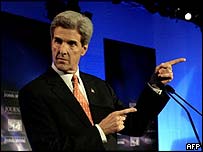
- "You know, education, if you make the most of it, you study hard, you do your homework and you make an effort to be smart, you do well. If you don't, you get stuck in Iraq."And what he meant to say:
- If you study hard you can do well in life, otherwise, you'll have to marry a rich heiress.
Subscribe to:
Posts (Atom)